
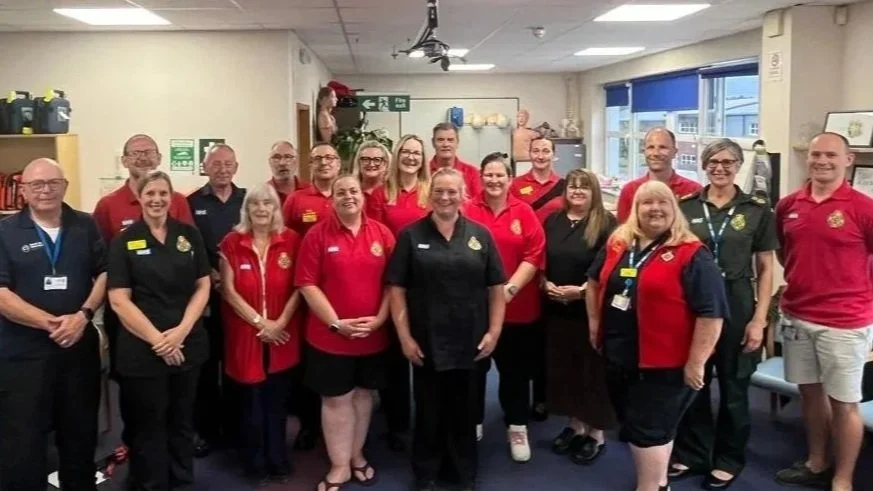
Ambulance Service General Volunteers
Our Ambulance Service General Volunteers (ASGV’s) To provide support to the Isle of Wight Ambulance Service including but not limited to the following areas: the Clinical Co-ordination Centre, Patient Transport and Non-Patient Transport / Fleet, Frontline, Emergency Preparedness Response and Resilience (EPRR) and the Ambulance Training and Community Response Services (ATCoRS).
Tasks will be asked as appropriate of the individual Volunteer and may include:
Staff Welfare – Provision of food and drink at Newport Ambulance Station, Combined Control Centre, at prolonged incidents and as appropriate whilst waiting for handover at the Emergency Department
Helping to maintain a pleasant working environment and support with housekeeping tasks within individual areas.
General administration support such as photocopying and scanning.
Feeding fish and checking water quality of fish tank
Assisting with fuelling of vehicles
Collecting and delivering items to support service areas e.g., uniform from our on-site sewing room / electronics from medical electronics department / equipment return from Emergency Department *
Sitting in the rear of a Patient transport vehicle to keep a patient company / provide reassurance on journey.
Simulate being a casualty for training purposes.
Basic gardening (raised beds only) e.g., weeding and watering.
Promote Ambulance Service Volunteering including the Community First Responder Scheme.
Seasonal decoration of areas e.g., Christmas
A friendly, happy person to welcome people back to areas after what may have been a bad day with stressful jobs. ‘Have a cup of tea’.
Collecting items that have been purchased locally e.g., milk, coffee etc. *
Meet and greet visitors.
Gather patient feedback as appropriate.
Phone calls to selected service users to prevent loneliness and refer as appropriate.
EPRR support including weekly ‘running’ of vehicles.
Any other ‘general’ tasks that do not require additional or specialist training.
To treat everyone with whom you meet, with dignity and respect.
Promote Equality & Diversity and a non-discriminatory culture. Identify and act when other people’s behaviour undermines Equality and Diversity.
Assist with various fundraising activities.
Act as a guardian for the Public Access Defibrillator(s) within the local community.
*Any tasks that involve driving will be in an Ambulance Service vehicle and the Volunteer must hold a full driving licence for that category of vehicle, have provided their licence details for a licence check and undertaken a driving assessment with the Driving Standards and Education Team PRIOR to any vehicle being driven.
Volunteer Ambulance Car Service Drivers
Our Volunteer Ambulance Car Service Drivers facilitate transportation, as dispatched by IW NHS Trust Ambulance Service, Clinical Coordination Centre (CCC), in vehicles provided by the Ambulance Service for this task. Patients are never conveyed in a volunteers personal vehicle.
Elements of the role include
Ensuring Trust vehicle checks are carried out and documented in line with training we provide.
Treating everyone with dignity and respect.
Convey all patients in a professional, comfortable, caring, safe and compassionate manner to and from hospitals and any other healthcare location specified within pre-determined schedules.
Ensure patients arrival is notified to area reception / clinic as appropriate.
Provide patients with care and assistance, only within the scope of training provided for this role.
Ensure patients are safely inside their home property and have SOS alarms, (e.g., ‘Wightcare’ call alarms) within easy reach / back on their person.
To ensure all patients arrive for appointments within the given appropriate timescales.
To ensure all data in relation to patient movements is recorded accurately.
Always maintain Patient confidentiality in accordance with Information Governance and Data Security Training
Promote Equality & Diversity and a non-discriminatory culture. Identify and act when other people’s behaviour undermines Equality and Diversity.
Act in accordance with the NHS constitution and NHS Core values (Annexe a).
All drivers of Trust vehicles (including volunteers) must adhere to a level of training and standards commensurate with their role. This includes a through working knowledge of the Highway Code, Road Traffic Regulations Act 1984, appropriate current supporting training and educational material, policies, procedures, and information that is circulated within the organisation. *
Volunteer Community First Responders
Our Community First Responders (CFR’s) are local unpaid volunteers who are trained and dispatched by the NHS ambulance service to attend life threatening medical emergencies and provide life support until the arrival of the local statutory NHS Ambulance Service.
Research has shown that in cases of cardiac arrest, fast access to emergency life support skills and equipment can increase pre-hospital survival rates from 5% to as much as 74%. There is also sufficient evidence that in the event of a cardiac arrest where the casualty’s heart is in a shockable rhythm, for every minute that passes without defibrillation their chance of survival decreases by 10%.
Our Volunteer Community First Responders use their own cars, no blue lights or sirens but being local means they can be on scene with a casualty in just a few minutes. They provide vital support until the arrival of the NHS Ambulance Service sometimes making the difference between life and death.
Who are Community First Responders and what is their role?
We are incredibly proud of our Volunteer Community First Responders (CFR’s). These people are trained by us to attend certain types of emergency calls in the area where they live or work. Being local often allows these amazing people to reach a casualty in the first few vital minutes before the ambulance arrives.
Their role is to help stabilise the patient and provide the appropriate and potentially life saving care until the more highly skilled ambulance crew arrives on scene to take over the treatment.
We periodically recruit for Volunteers, and usually run a training course for CFRs yearly. If volunteering for the Ambulance Service is something you would like to apply to do please complete the ‘my details’ form and we will endeavour to send you an email to the address provided when we advertise next. Please keep an eye out for the email.